About human imagination, design and other amazing worlds (...because all my life is a link!)
I misteri del lago Vostok dopo trent'anni di scavi Foto - Repubblica.it
I misteri del lago Vostok
Un team russo rompe l'ultima barriera di ghiaccio e raggiunge un bacino di acqua temperata sepolto da milioni di anni. Un mondo isolato e autonomo rispetto alla Terra, la cui scoperta pone serie questioni ambientali. Con tanti interrogativi e anomalie, al momento senza risposta di TIZIANO TONIUTTI
UN MISTERO lungo venti milioni di anni, sepolto sotto i ghiacci del Polo Sud 2. E' quello racchiuso nel lago Vostok, subglaciale e grande come l'Ontario, lungo quasi 250 chilometri e largo 50, profondo 1000 metri, il più grande delle centinaia di bacini sotto il Polo sud. Forse gli strati che ricoprono il lago sono più recenti, nell'ordine delle decine di migliaia di anni. Ma tradotti in misure, equivalgono comunque a tre chilometri e oltre di spessore glaciale, che le trivelle russe impegnate nella spedizione hanno finito di perforare oggi, dopo trent'anni di lavori. La zona di Vostok è ammantata di mistero oltre che di ghiaccio, da sempre. Non ultima la sparizione del team di scienziati impegnati nei lavori in questi giorni, di cui hanno dato notizia network importanti come la Fox, poi riapparsi improvvisamente dopo una settimana di comunicazioni interrotte. E la vera avventura comincia adesso, perché fare luce sui misteri del lago, l'ambiente che lo circonda e le sue anomalie potrebbero rappresentare per la scienza un episodio non distante per importanza dalla conquista della Luna negli anni 60.Riusuke Fukahori: Goldfish Salvation at ICN Gallery
'goldfish salvation' by riusuke fukahori at ICN gallery in london, united kingdom
image © dominic alves
Hosted by ICN gallery, japanese contemporary artist riusuke fukahori makes his london debut with
'goldfish salvation', a collection of paintings and sculptures revolving around the often colourful freshwater fish.
what looks to be an actual goldfish frozen in time is a careful construction of casting resin which has been
layered with acrylic paint. section by section, fukahori builds up the fish with fleeting brushwork,
resulting in an effect that resembles motion blur underneath water.
cast in a variety of vessels - from large sushi basins to the hollow insides of black bamboo - the 'living sculptures'
are a delicate balance between painting and sculpture. the artist's meticulous attention to detail coupled with
the tedious nature of the style creates highly dynamic three-dimensional pieces that capture the delicacy and
animated life of the fish.
Gabriel Orozco, Tatiana Bilbao, Orozco’s house-observatory, Oaxaca (Mexico) 2008
critical text by Stefano Boeri
![]()
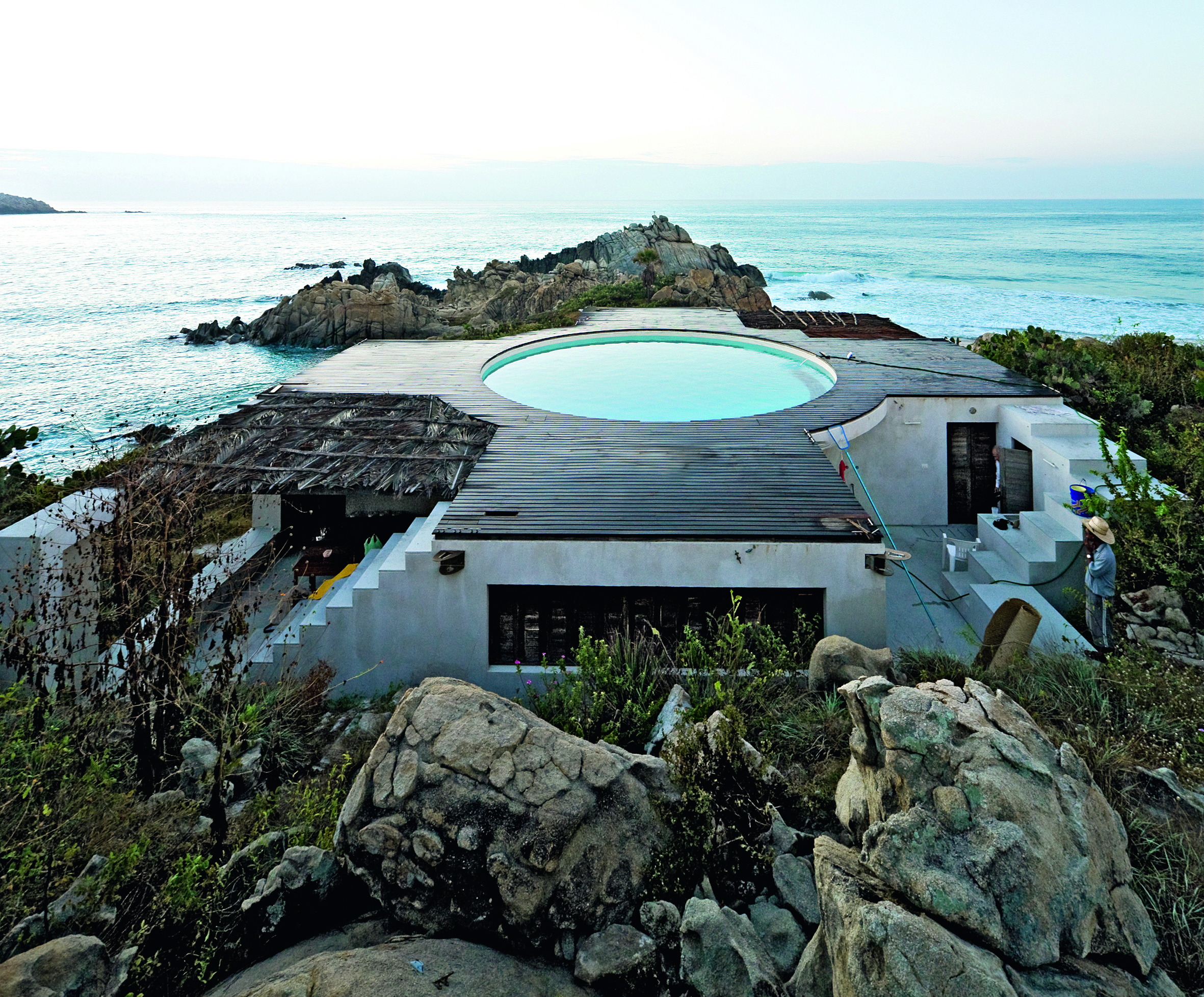
The house-observatory in Roca Blanca by the artist Gabriel Orozco, designed in collaboration with the architect Tatiana Bilbao, who is also Mexican, blends a principle of settlement camouflaged into the landscape with a location aware device.
The house, set into a rocky promontory overlooking the Pacific Ocean, is a 1:1 replica of one of the structures that forms the Jantar Mantar astronomical observatory, built in Delhi in 1724, which the artist visited in 1996.
Going back to a theme particularly relevant to other famous solitary camouflaged residences set into rocky panoramic high ground, starting from the promontory-house Malaparte by Adalberto Libera in Capri, next there is the house-bunker designed mother Cini Boeri in La Maddalena, the house-observatory in Roca Blanca which is madeup of an exchange of glances: from the landscape and towards the landscape.
The genetic code of the original observatory which inspired Orozco is conserved and translated into the idea that a home continues to be operational just as a visual device within its natural environment.
In fact, the convex section of the panoramic outdoor swimming pool determines a circulation of waves at its edges and all the views are always facing outwards.
Thep resence of water in the centreof the house, resting on the floor and in connection with the sky reveals a kind of mystic paradigm of the observatory’s spatial concept. At night, in the centre of this sphere one can feel the temperature of the water and perceive, in a certain position, the force of gravity. When darkness is all around, one feels as if one is floating in space.
The total absence of any kind of stylistic obsession whatsoever makes the action of this visual architectural device even stronger and more convincing.
tatiana bilbao: construction of 'gabriel orozco house', roca blanca, mexico, 2008
'gabriel orozco house', roca blanca, mexico, 2008
(gabriel orozco and tatiana bilbao)
photo: iwan baan
![]()
construction of 'gabriel orozco house', roca blanca, mexico, 2008
images © tatiana bilbao
Mitch Dobrowner, "the storms hunter"
Amazing black-and-white shots which depict the dramatic, calm beauty of stormsThe majestic fury of a storm, symbol of both human fragility and strengh, has always been considered as sublime. Although many love to observe it, only few braves have had the courage to capture its beauty: among these, Mitch Dobrowner, the "storms hunter".
His amazing black-and-white pictures let appreciate the beauty of storms, despite the disasters they generate.
Dobrowner's photographs are intensly dramatic: big clouds and lightnening make the view extremely powerful. "When taking photographs, time and space seem hard for me to measure. Whenever I shoot a ‘quality’ image, I know it. At those moments things are quiet, seem simple again – and I obtain a respect and reverence for the world that is hard to communicate through words. For me those moments happen when the exterior environment and my interior world combine. Hopefully the images presented help communicate what is visualized during those times", stated the photographer.
His passion for storms was born a long time ago when he was still a child: ever since his job has been to record this world of light and shadow in a magic, indefinite time.
Piotr Kaczmarek - Leafless Trees
Edward Steichen The Spiral Shell
The Spiral Shell, France, vers 1921 Courtesy The Richard and Jackie Hollander Collection, Los Angeles © Joanna T. Steichen
Nervous System – explorations in generative design and natural phenomena
Hyphae Lamps – an infinite series of lighting designs
The Hyphae Lamp is a new series of algorithmically generated lighting designs by Nervous System. Each lamp is individually grown through a process based on leaf vein formation. No two lamps are alike. Each casts a unique pattern of branching shadows on the wall and ceiling, creating an ethereal and organic atmosphere. The lamps are 3D-printed to order in nylon and illuminated with eco-friendly LED lights. The first 10 lamps in the series are now available for purchase.
GROWTH PROCESS VIDEO
video not showing up? watch it on Vimeo.com here: Hyphae Lamps. Special thanks to Graham Woolley / scion eidolon for creating the music.
Nervous System
Organic Jewels. Deconstruction: Cell Cycle by Nervous System | Design Milk
via design-milk.com
This month’s Deconstruction comes from Nervous System, a product design company founded in 2007 by Jessica Rosenkrantz and Jesse Louis-Rosenberg. Using their backgrounds in architecture, design, math and biology, they create one-of-a-kind organic-looking yet algorithmically created accessories including rings, necklaces and earrings, which we’ve featured a number of times. Check out how they developed their Cell Cycle line and find out how you can create your own.
Cell Cycle is a line of 3D printed nylon and stainless steel jewelry. It is based on our interest in 3D forms, cellular patterns, and the idea of subdivision (cell splitting). The pieces were designed using custom software that we created. Instead of sculpting the pieces by hand or modeling them in a commercial software, we wrote our own program that encodes a system for creating 3d form. We call this process “computational design.” I am going to take you through some of the development of these pieces. Because most of the steps occurred in the computer instead of in the physical world, it probably looks a little different than your typical product development.
Moving Sculptures by Bernard Reyboz. An organic artist
Reyboz from Dana Sardet on Vimeo.
Sculptures mouvantes de Bernard Reyboz, artiste à Antibes, France.